Good And Real, chapter 2A notes
The real p-zombies were the people calling me a p-zombie along the way

I’m in a reading group for “Good and Real” by Gary Drescher. These are my notes for chapter 2, sections 2.1-2.3 (inclusive)
re: Computationalism
By monitoring brain activity, we can see different regions of the brain performing computations when different sorts of cognitive functions are performed (language, singing, spatial imaging, etc.). And when certain brain regions are damaged by injury or illness, the corresponding cognitive abilities degrade or vanish.
A quick explanation of computationalism, which states consciousness is the result of certain computations being executed, I’m already on board with.
re: Paradoxes of Computationalism
If these seeming contradictions are cleared up, we will have no more reason to suspect that our minds include a non mechanical, extraphysical component
While I appreciate paradoxes being cleared up, people will absolutely still suspect that our minds include ghosts. “There’s no more paradox so it must be legit” is just not how people work. Also, this very timely LW post points out that compiling a supposedly exhaustive list of objections and resolving them all is The Most Common Bad Argument In These Parts.
re: p-Zombies
first, the setup:
Leibniz, in his seventeenth-century theory of monads, proposed that mind and the nonmental world, though lacking any influence on one an other, remain synchronized by a ‘‘preestablished harmony.’’’ Each is independently rigged so that its entire future unfolds in a way that will mesh with the other
Gorgeous theory, and also is a reducto ad absurdum for anyone who doesn’t believe in an initial synchronizer (God). And if you already believe in God, do you really need this weird parallel universe? Why not just believe in souls directly? Still, it’s beautiful to think about. This primes us with the absurdity of having perfectly non-interacting but synchronized universes to beat the old zombie-horse of….
p-Zombies
[minds] are indeed implemented mechanically, computationally, by our neurons. Still there is something else: an extraphysical consciousness that is somehow generated by the physical, computational events in your brain. Without that consciousness, your body would still behave as it always does—the difference would be externally imperceptible.
Or as a philosopher friend of mine put it — the consciousness field is perturbed by the physical computations. The physical stuff in the real world doesn’t feel anything, but it agitates something using unknown physics, which is where consciousness happens. But Drescher then points out that since this consciousness can’t affect the physical world all the atoms are:
when you say things like ‘‘But I can feel that I have consciousness. It does not feel like there’s just electrochemical activity taking place in my brain,’’ your saying or thinking that could not be in any way influenced or explained by your extraphysical consciousness
Even if your extraphysical consciousness were real, the apparent perception of it by your physical brain would still be illusory [...] and thus not be due in any way to what is supposedly perceived. If you would perceive (and report and remember) the same thing with or without the existence of extraphysical consciousness, then that perception (or report or memory) constitutes no evidence for extraphysical consciousness.
Anything you think you perceive about consciousness is necessarily an illusion, since you can’t perceive anything in the consciousness universe. Your own consciousness is thus an illusion, because the actual consciousness is in a separate universe. It might be exactly mirroring what you are perceiving, but that’s either an absurd coincidence, or is proof that something exists which orchestrated this synchronicity. Regardless, you don’t have access to it because your perceptions and thoughts are processed by your physical body. It turns out the people calling me a p-zombie were the real p-zombies all along :P
Poor Chalmers can’t catch a break.
Other people in the reading group disagreed with me, and brought up Scott Alexander’s post P-Zombies Would Report Qualia

I think this post must be some kind of scissors statement, because the two lines
“My reportable mind receives the color information as a 2D grid in which each pixel conveys a irreducible sudden intuitive sense of being the correct color”
and
“I experience the mysterious redness of red”
Sound like basically the same sentence to me, one of them just using more vulcan-ish language.
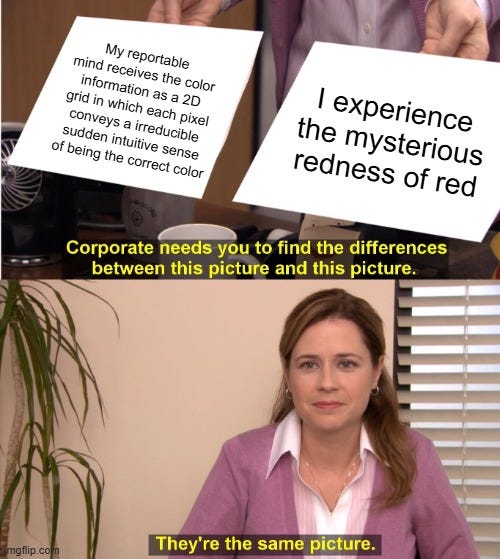
Yet Scott says that these are two different things, and that this difference is so strong it supports P-Zombie-ism?? I’m very confused here... wtf are people experiencing that is not “an irreducible sudden intuitive sense of being X” when they say they are experiencing qualia? I thought that’s what the word meant.
Though I guess if even Scott couldn’t put into words what’s different about them then there’s not much chance any other English-speaker could
re: consciousness
Here Drescher lays out his own understanding of what consciousness is.
there is an internal memory system— [Cartesian Camcorder]—that records a stream of selected mental events— perceptions, thoughts, and so on—that the machinery deems salient. A recorded event can be played back and ‘‘watched’’ by other parts of the cognitive system, either immediately or much later; this process turns out to be what consciousness consists of. The cognitive system represents and can calculate various relations among those terms of representation: how the represented objects or states relate to one another, what affected what else, what depended on what else, what else would have gone differently if some event had been different, what events are desirable, how a different choice of action in the future might lead to a more desirable (or less desirable) outcome
The cognitive system’s knowledge of such interrelatedness facilitates the system’s pursuit of goals
our ability to learn from replaying past events and thoughts is presumably what would have prompted the evolution of a record-and-playback faculty in the first place.
that smart recording and playback of a given mental event is your consciousness of the event.
consciousness is a property that is endowed upon a cognitive event retroactively [even sub-second]
thus
what is required is itself a particular physical, computational event.
This sounds entirely plausible to me, and I’m willing to accept it. However at this point it sounds like a hypothesis that needs some sort of backing with experiment. This is the problem with philosophy. It’s all stuff that sounds good but without empiricism it’s not that useful. I guess if nothing else when someone demands “Ok but if no souls than what is consciousness, huh?” one can point at this and say “Could be that! More likely than invisible ghosts or parallel universes with one-way causality!”
When we envision an entity behind some observations and construe the observations as manifestations of that entity, we reify (i.e., ‘‘make real’’) the source of the observations
I didn’t understand what was being said here. Others in my reading group clarified that this is a way of saying “You don’t HAVE thoughts, you ARE thoughts.” And referred me back to the Center Node in the network of How An Algorithm Feels From The Inside. This is why reading groups are great. :)
there is nonetheless a process of observation—the Cartesian Camcorder’s smart recording and playback of an event—that is distinct from the observed event itself, and by virtue of which the event is conscious
This is Drescher’s ultimate conclusion. Consciousness is the Catesian Camcorder playing an event back (and it can playback itself pondering on itself). This is fine, but I already know my non-zombie-friends will not be satisfied by this. They will continue to ask “but why does the playback feel like something, as opposed to nothing?”
Even if a computational system records and replays representations of many of its thoughts and perceptions, there is still something puzzling about the idea that it thereby has a conscious experiences of those events.
Oh good! He anticipated this, and states it here. He doesn’t go into it though, perhaps that’ll come in 2.4, or later.
Re: Interpreters as Consciousness
In 2.3 Drescher points out that any encrypted message can be turned into any other encrypted message by using the right key (assuming its a complicated enough key).
The joke here, of course, is that any message can be construed as a substitution-cipher encoding of any other message (of the same length), simply by contriving the appropriate key.
He goes on about this for the entire section, pointing out that we can interpret a rock as a computer program (or a mind!) by altering the key we use to interpret its atoms at every planck-length-second. But that this doesn’t mean the rock is a computer program, or is conscious. I thought this was so obvious I wasn’t sure why he spent an entire section harping on about it, and I didn’t take any more notes.
I guess I was in error, because some of my reading group still wasn’t sure why the rock couldn’t be seen as conscious with the right cypher/interpretation program. The short answer is because it’s the cypher/interpretation program that is conscious (or the thing that created the cypher). They’re fooled by a slight of hand at looking for consciousness in the acted-upon object rather than the actor. Consciousness is a process.
That’s all for this section. As a bonus, in addition to Scott Alexander’s post, we also touched on Global Workspace Theory, so here’s my notes on Larissa Schiavo’s primer on GWT.
Global Workspace Theory
Human and animal brains use a bunch of specialized systems (modules) that perform certain kinds of cognitive tasks independently and in parallel - one module handles vision, one handles language, one handles emotions, etc.
But we don’t just experience ourselves as senses of smell; we’re multimodal girls living in a multimodal world(s)4. We typically experience all these different sensory components together in one coherent mind, a shared area called the global workspace.
Once a module puts something in the global workspace, it can be seen and used by the other modules. Vision informs memory, memory informs language, language informs decision-making.
GWT’s core schtick is that an entity is conscious if and only if it makes it into the global workspace and globally broadcasts
consciousness has a big network of “workspace neurons” distributed across the board, especially in the frontal and parietal areas of the brain.
activity suddenly surges in these workspace neurons, when they process this information. This is called “ignition.” Ignition is a binary switch: it happens, and the thing gets broadcast or it doesn’t. There’s no semi-ignition.
And we discussed Tim Duffy’s findings that LLMs do seem to reply prior recorded events, which would move them closer to “maybe conscious!” if the camcorder model is solid.